English Teaching Methodology:
From Theory to Classroom Practice
A practical teacher-training course for English teachers who want to understand how effective lessons work — and how to make better classroom decisions.
Over seven weeks, you will study core areas of ELT methodology, practise key classroom techniques, complete teaching practice with real students, and receive professional feedback on your lesson recording.
Live participation required · Recordings are not provided · Schedule to be confirmed
Approaches, communicative teaching, lesson aims, staging, and principled classroom decision-making.
Grammar, vocabulary, eliciting, drilling, instructions, error correction, assessment, and feedback.
Three practical blocks, a 30-minute lesson with real students, and individual trainer feedback.
Course Format
A live online course built around active participation, practical work, and professional feedback.
Duration
7 weeks
Format
Live online sessions in Zoom
Schedule
Twice a week; exact timetable to be confirmed
Group size
Up to 8 participants
Language level
C1 and above
Recordings
Not provided
Practice
3 practical blocks with teaching practice and lesson observation
Certificate
Certificate of completion
The course is built around live participation. You will be expected to attend the sessions, take part in discussions, complete self-study tasks, prepare teaching practice, and reflect on feedback.
Because the course involves interaction, discussion, and practical classroom work, recordings are not provided. The value of the programme comes from being present, asking questions, observing teaching decisions, and receiving feedback in real time.
Syllabus
Seven weeks of structured methodology training, moving from core teaching principles to teaching practice, observation, and feedback.
You will explore major approaches to language teaching and consider how communicative methodology changes the role of the teacher, the student, and classroom tasks.
You will learn how to present and practise grammar and vocabulary more effectively, using eliciting, checking understanding, controlled practice, and drilling.
You will look at how receptive and productive skills are taught, how tasks are staged, and how language input can lead to meaningful classroom communication.
You will work on classroom procedures, grouping, lesson pace, task management, and instructions that help lessons run smoothly.
You will learn how to correct errors, when to interrupt and when not to, how to give feedback, and how assessment can support learning rather than simply measure it.
You will discuss how to select, adapt, and design supplementary materials, and how teachers can continue developing after the course.
The final week is devoted to teaching practice, lesson observation, reflection, and individual feedback.
Teaching Practice and Lesson Observation
The practical component is central to the course.
During the programme, participants complete three practical blocks. These include teaching practice and individual lesson observation.
You will teach a 30-minute lesson or lesson fragment with real students. You will also submit a recording of your lesson for observation and receive feedback from the trainer.
The aim is not to “perform a perfect lesson”. The aim is to learn how to analyse your teaching, notice what happens in the classroom, and make better methodological decisions next time.
This practical format helps you connect the course content with real teaching: instructions, staging, interaction patterns, correction, feedback, and student engagement.
How the practical blocks work
Three opportunities to teach, reflect, and receive professional feedback.
Prepare a lesson fragment
You plan a 30-minute lesson or lesson fragment based on the course methodology.
Teach real students
You conduct the lesson with real learners and record it for observation.
Submit the recording
The trainer observes your lesson recording and analyses key methodological decisions.
Receive feedback
You receive professional feedback on lesson aims, staging, instructions, interaction, correction, and student engagement.
3 practical blocks · 30-minute lesson fragments · Real students · Trainer feedback

Meet Your Trainer: Victoria Gracheva
Victoria Gracheva is an English language teacher based in Saint Petersburg and an experienced teacher trainer. She has been preparing teachers for TKT and delivering TEFL training since 2012.
Victoria’s work focuses on practical methodology, teacher development, lesson observation, and helping teachers make more informed classroom decisions. Her approach combines clear methodological principles with real teaching practice.
Her qualifications and professional experience include:
- English Language Teacher, Saint Petersburg
- TKT preparation and TEFL trainer since 2012
- CELTA qualified
- DELTA Modules 1 and 2 qualified
- Experience in lesson observation, feedback, and teacher development
Her training principle is clear:
effective teaching is not a set of tricks, but a skill that can be analysed,
practised, and improved.
Certificate and course documents
Participants who attend the course and complete the required practical assignments receive a Certificate of Completion confirming participation in a seven-week teacher-training programme.
The course documentation confirms:
- participation in a seven-week teacher-training programme
- completion of live online methodology sessions
- guided self-study and practical assignments
- teaching practice and lesson observation
The programme covers core areas of ELT methodology:
- lesson planning and communicative teaching
- grammar and vocabulary teaching
- reading, listening, writing, and speaking skills
- classroom management, correction, assessment, and feedback
Standard-format Professional Development Certificate (yдостоверение установленного образца)

Certificate of Additional Education
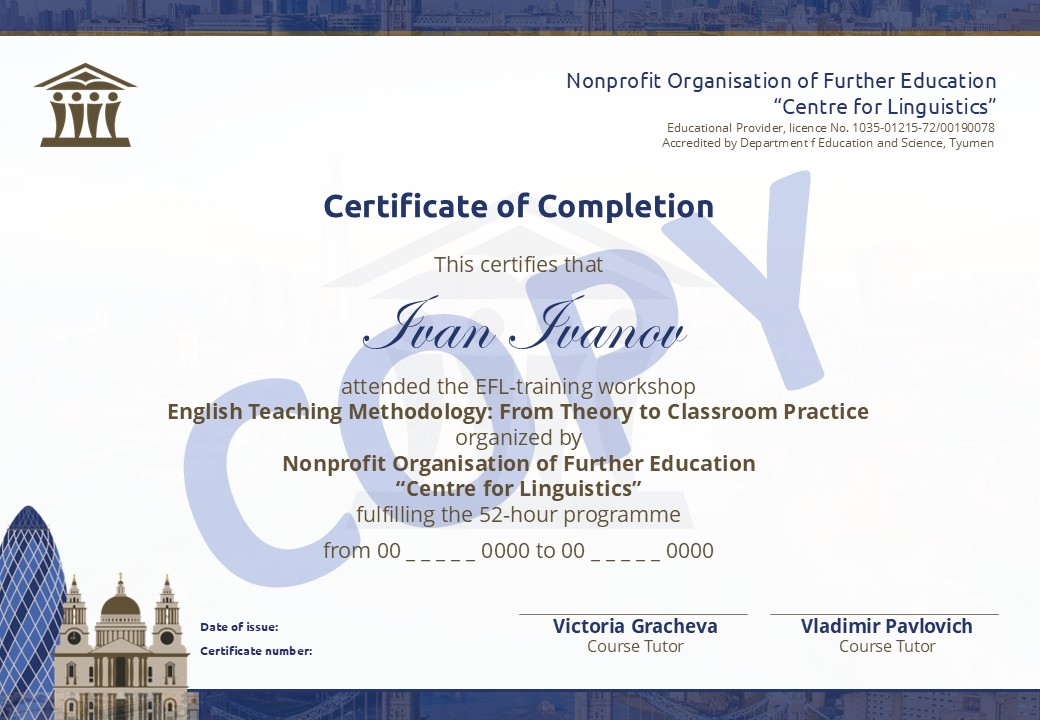
Sample certificates. Certificate is awarded upon attendance and completion of the required practical assignments.
Price
The course fee includes live methodology sessions, practical teaching blocks, individual feedback, and a certificate of completion.
Early bird price
Available for participants who pay in full before 1 June. Limited-time registration price
Full course fee
Full access to the seven-week teacher-training programme.
Includes:
- 12 live online sessions
- 3 practical blocks / lesson observations
- teaching practice with real students
- guided self-study
- individual feedback from the trainer
- certificate of completion
Payment in two instalments
For participants who prefer to split the payment.
This option allows you to reserve your place and complete the payment in two parts.
The group is limited to 8 participants to allow for discussion, practical work, and individual feedback.
Frequently Asked Questions
Key information about the course format, requirements, teaching practice, and certificate.
No. The course is suitable for beginning teachers, but you need a strong command of English and a willingness to participate actively.
You need English level C1 or above, as the course is conducted in English and includes professional reading, discussion, and teaching practice.
No. The course is delivered live, and recordings are not provided. The format depends on active participation, interaction, teaching practice, and real-time feedback.
Yes. The course covers many key areas relevant to TKT and CELTA, including methodology, lesson planning, classroom management, language systems, skills work, correction, and feedback.
Yes. Participants complete teaching practice with real students and submit a lesson recording for observation and feedback.
Yes. Participants who attend the course and complete the required practical assignments receive a Certificate of Completion.
Still have questions? Contact us before applying, and we will help you decide whether the course matches your teaching goals.